Both of these are about as good as a phone gets in 2026. Neither one is going to disappoint you on paper. What actually separates them isn’t a spec-sheet gap, it’s philosophy. Apple is still betting on refinement and consistency; Samsung is betting on features and raw capability. Once you see that split, the question stops being “which phone is better” and becomes “which approach fits how you actually use a phone.”
Here’s how they actually stack up, category by category.
In the hand
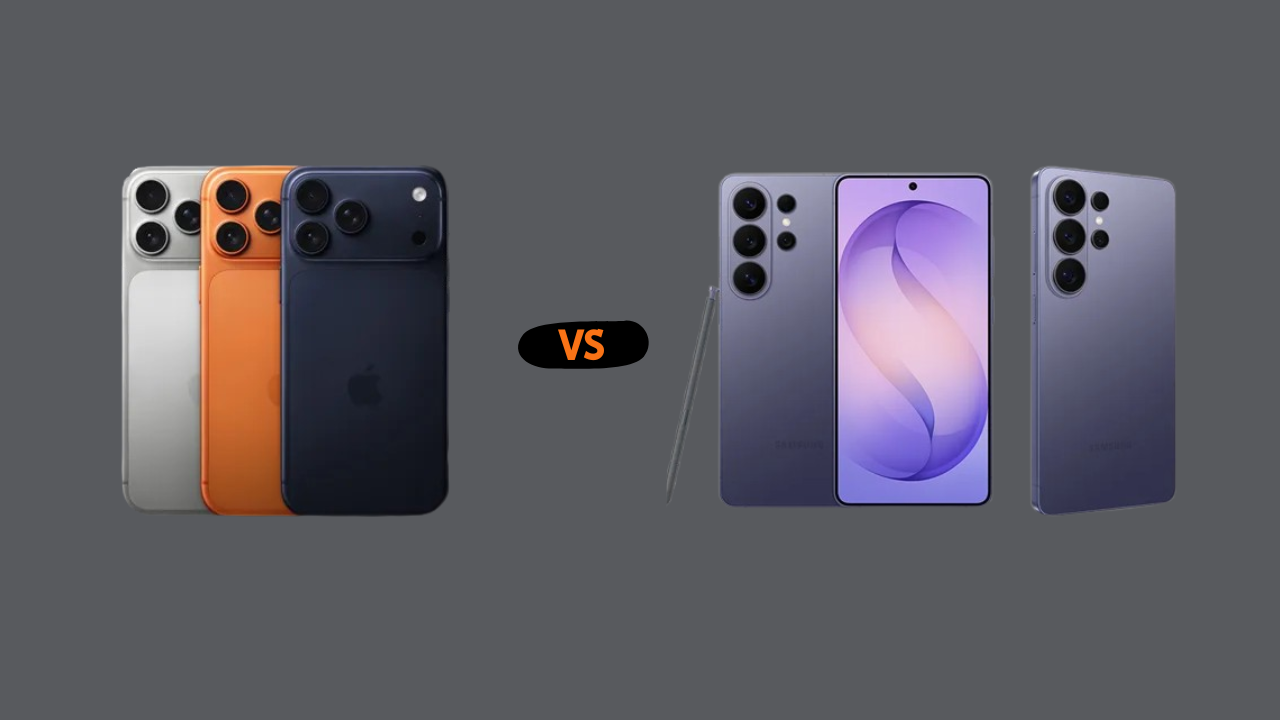
The 17 Pro Max feels dense and deliberate, flat edges, tight construction, weight that’s noticeable but well balanced. It’s not flashy, but it feels controlled, like Apple sweated every millimeter of tolerance. Built for someone who wants the same phone to feel this solid in year three as it did on day one.
The S26 Ultra goes a different direction. Slightly lighter than you’d expect for its size, with a flat, boxy shape that reads more like a tool than a jewel, less minimal, more purpose-built. It’s the phone that looks like it wants you to do something with it, rather than just admire it.
Neither is objectively better here. It’s genuinely a preference call between “refined and quiet” and “bold and functional.”
Screens: accuracy vs. spectacle
Apple’s Super Retina XDR panel is tuned for realism, accurate color in natural scenes, strong brightness, excellent outdoor visibility, nothing exaggerated. It’s a screen built to disappear into the content, not compete with it.
Samsung’s Dynamic AMOLED goes the other way; richer colors, deeper contrast, extremely strong outdoor brightness, and the higher resolution gives media an extra layer of sharpness that’s genuinely noticeable in day-to-day scrolling. If you want a screen that makes everything look a little more alive, this is the one.
If you care more about color accuracy than punch, Apple wins this round for you. If you want a screen that shows off, Samsung does.
Performance: predictable vs. peak
Day to day, both are fast enough that you won’t notice a difference in casual use. The gap shows up under load.
The iPhone stays remarkably consistent, apps launch instantly, multitasking never stutters, and performance doesn’t waver much between light and heavy tasks. It’s the phone that behaves the same way in month six as it did on day one.
The S26 Ultra is faster at its peak, especially in multitasking and split-screen workflows, but its behavior is a bit more variable depending on how hard you’re pushing it. You get more headroom, at the cost of a little less predictability.
Gaming tells the same story from a different angle. Across 4+ titles, the iPhone held smooth, sustained frame rates with only mild warmth even after extended sessions, it optimizes for staying steady rather than chasing peak numbers. Samsung, tested across 10 titles, hit higher peak frame rates and handled extended high-performance sessions well, occasionally dialing back slightly under heat to manage thermals, but even then, frame consistency barely moved. If you play competitively or push graphics settings to the max, Samsung’s ceiling is higher. If you just want it to feel the same every time you pick it up, Apple’s approach wins.
Cameras: honest vs. versatile
This is the clearest philosophical split of the whole comparison.
Apple’s camera plays it straight, natural, consistent photos across lighting conditions, accurate skin tones, well-balanced exposure. Low light is a particular strength, with strong detail retention and controlled noise. It’s not the most dramatic camera you’ll use, but it’s dependable in a way that doesn’t require thinking about settings.
Samsung leans into flexibility and punch, photos often come out more detailed and more processed, and the zoom and long-range photography system is genuinely more capable than Apple’s. That versatility comes with a tradeoff: results can vary more depending on the lighting you’re shooting in, where Apple stays steadier.
If you want a camera you can trust without thinking about it, Apple. If you want more creative range and don’t mind some inconsistency in exchange, Samsung.
Battery and charging: similar endurance, different charging philosophy
Both comfortably get you through a full day of heavy use, there’s no real loser here on raw endurance. The gap is in charging. Samsung charges noticeably faster, which shows up as a real, tangible convenience if you’re the type who tops up in short bursts throughout the day. Apple’s charging is slower but stable, no drama, no surprises, just a predictable curve.
If charging speed matters to your routine, that’s a real, measurable win for Samsung. If you don’t think much about charging and just plug in overnight, it barely matters.
Price in Nigeria
As of May 2026, the iPhone 17 Pro Max is available in Nigeria for around ₦2,000,000 – ₦2,600,000, depending on storage variant and where you buy.
| Retailer | Price Range | Notes |
|---|---|---|
| Jumia | ₦2,260,000 | Official store, warranty included |
| Pointek | ₦2,320,000 | Physical store in Lagos |
So which one should you actually buy?
If you’re already deep in the Apple ecosystem, or you want a phone that behaves exactly the same way every single day without you having to think about it, get the 17 Pro Max. It won’t wow you with any one feature, and that’s kind of the point.
If you want more raw capability, faster charging, a more flexible camera, higher performance ceilings, and you don’t mind a little more variability in exchange, the S26 Ultra is the more powerful phone, full stop.
There’s no absolute winner here, and I don’t think there’s supposed to be one. The S26 Ultra feels more powerful and versatile. The 17 Pro Max feels more stable and refined. Which one is “better” really does come down to which of those two words matters more to how you actually use your phone.